Monday, 7 December 2015

Publication of Microhistory Issue (Vol.4, No.2)

After the proud publications of our issues on Ognijug (Vol. 1, No.1), Bengali Cinema (Vol.1, No.2), Bengali Theatre (Vol.2, No.1), Science and Technology in History: Modern Bengali Perspectives (Vol.2, No.2), Literature and Movements: Bengali Crossroads (Vol.3, No.1) Kolkata (Vol.3, No.2),  Bengali Music: Bengalis and Music  (Vol.4, No.1),  Journal of Bengali Studies is happy to announce the online publication of its Winter Issue 2015 on the theme of Microhistory: Bengali Perspectives on the occasion of the Day of Storming Headquarters, 8 December 2015. 

You can read the issue from here   

JBS Microhistory Issue (Vol.4, No.2)

Journal of Bengali Studies  (ISSN: 2277-9426)
 Vol. 4, No. 2    
8 December 2015  
Day of Storming Headquarters   
 21 Ogrohayon 1422  
Winter Issue  

 Microhistory: Bengali Perspectives  

Editor: Tamal Dasgupta     
  

Contents  

 Editorial 7  

 Commentary  

Towards a Microhistoriography of Bengali People: Excavating the Ruins of Remembrance and Forgetting     
Tamal Dasgupta 9  

Localizing Texts and Textualizing Locations: A Survey of  the Historical Geography of Nabadwip  
Somnath Sarkar 17  

 Article  

Evolution of Folk Songs of Twentieth Century Bengal  
Sayantan Thakur 21  

Patni  System and Subinfeudation Rights in Bankura  
Arundhuti Sen 26  

Situating Ramaprasad Chanda  
Rahul Kumar Mohanta 38  

Changing Role of Women in Vaishnavite Cult of 17th Century Bengal  
Laboni Sarkar 47  

Mythology and Folklore of Water Resources in Bengal  
Sourav Maity 52  
   
The Bengali Othello in Pre-Independence Newspapers: The Question of Race and Hybridity  
Abhishek Chowdhury 60  

Vaidyas of Bengal 
 Raibatak Sen Gupta 74  
   

 Review 

A Review of Jyotirmoy Roy's History of Manipur  
Sanjay S. Ningombam 110  


Friday, 6 November 2015

Notice

Season's greetings to our readers, contributors, well-wishers!

Instead of Kalipujo, the upcoming microhistory issue of JBS Vol.4 No.2 will be published on the occasion of the Day of Storming Headquarters, 8 December 2015. On this day, in 1930, revolutionaries of Bengal Volunteers Badal Gupta, Benoy Bose and Dinesh Gupta entered Writers' Building and fought a pitched battle there.

The deadline for submission of articles, reviews etc. is now extended to 25 November 2015.

---Editorial Board, JBS

Badal Gupta
Benoy Bose


Friday, 19 June 2015

Call for Papers for JBS Vol.4, No.2 on the theme of Microhistory: Bengali Perspectives


Call for Papers for JBS Vol.4, No.2 on the theme of Microhistory: Bengali Perspectives


After the proud publications of our issues on Ognijug, the age of revolutionary nationalism in Bengal (Vol.1, No.1), Bengali Cinema: Bengalis and Cinema (Vol.1, No.2), Bengali Theatre: Bengalis and Theatre (Vol.2, No.1), Science and Technology in History: Modern Bengali Perspectives (Vol.2, No.2), Literature and Movements: Bengali Crossroads (Vol.3, No.1), Kolkata (Vol.3, No.2), Bengali Music: Bengalis and Music (Vol.4, No.1), Journal of Bengali Studies (JBS), a peer reviewed interdisciplinary online academic journal (ISSN: 2277- 9426) meant for scholarly discussions into the history and culture of the Indic Bengali people, is pleased to announce the Call for Papers for its eighth issue (Vol.4, No.2) on the theme of Microhistory: Bengali Perspectives, due to be published on the occasion of Kalipujo, 23 Kartik 1422, 10 November 2015. The final date for submission of article/review/workshop is 31 October 2015. Commentaries in JBS are accepted by invitation/commission alone. If you want to author a commentary instead of a regular article or review, or want to know how they are different, please get in touch with the editorial board beforehand at shoptodina@gmail.com

Microhistory: Bengali Perspectives
The theme of JBS Vol.4 No.2 is Microhistory: Bengali Perspectives.
Existing models of historiography mostly qualify as macrohistory and often don't do justice to several smaller events, minute timelines, localized events of a caste/community, oral histories, narratives from a specific locality, and that's why microhistory emerged in western academia during 1970s, 80s and 90s as a distinct method to approach various socio-cultural issues which are often silenced and marginalized within the ambit of professional historical research.
Microhistory is the study of the smaller histories. Microhistory can be the annals of a certain district, a specific community, a particular class, a certain caste. Microhistory might involve the study of a specific event, a certain oral history, a certain fair, a certain gathering from the remote and/or recent past.
To the best of our knowledge, this will be first systematic use of microhistorical methodology to study the events, societal formations, cultural aspects and human geographies of the Bengali people, though many proto-microhistorical attempts have been made in the past. Ishwar Chandra Gupta's study of different districts of east Bengal qualifies as a proto-microhistory, for example.


The topics for contribution will include the following but will not be exclusively limited to the same.
  • History of the Bengali diaspora, . Colonies of Bengalis in different Indian states and territories: the stories of Bengalis settled outside Bengal. Bengalis outside India.
  • Specific counter-cultures of Kolkata Bengalis which set them apart from mainstream India, non-aesthetically (or anaesthetically) dominated by commerce, power, interest. Film Society movement. Little Mag movement. Group Theatre movement. Bengali music as a form of rebellion from Salil Choudhury to Rupam Islam.
  • Clubs as community formation. Organization of Baroyari Durgapujo.
  • Bengali snacks (e.g. telebhaja, rolls) and sweets, Bengali eateries and food culture.
  • Bengali romance with books. Writers, Publishing houses, College Street Boipara, Kolkata Book Fair, book shops in the districts.
  • History of the various regions, districts, cities, villages, localities of Bengal. Archaeology and new townships. Juxtaposition of exotic antiquities and casual, callous, amnesiac everyday.
  • Bengalis in education. Histories of schools, colleges, universities, institutes. Histories of students and youth organizations, movements. Histories and legends of teachers.
  • Bengalis in business.
  • Topography of water, rain, monsoon, rivers, ponds waterbodies, boats and fishermen.
  • Histories of farmers and farming. Rituals and festivals associated with agriculture.
  • Histories of cultural celebrations, religious rituals, festivals, social gatherings. Rother Mela, Shib Ratri, marriage ceremonies etc.
  • Little histories of Partition. Histories of displacement. Setting up of refugee colonies, oral history, family narratives.
  • History of Bengali castes, sub-castes, communities, professional classes.
  • Bengali fondness for travel. Travels to Puri, Digha, Darjeeling.
  • Bengalis and internet. Community formation, politics, cultural groupings and events in Facebook and other social networking sites.
  • History of Suburban culture. Stations, markets, livelihood, office-goers, local trains.
  • History of Western, Russian and Chinese influences on Bengali culture. Bengalis and European languages and literature (including the Bengali tryst with English), Bengali literature and Naxalism, the realm of Soviet books in Bengali.


General details about submissions to Journal of Bengali Studies:

Journal of Bengali Studies is published in English and is an online journal. A contribution must be electronic and in English language. It should consistently follow any one of these three scholarly styles of citation: MLA style, Chicago Manual of Style and APA style. Contributions must always be 1.5 line-spaced. An article, with manually edited notes and bibliography (DO NOT use the footnote and endnote mechanisms of your writing software e.g. MS Word, and instead just manually insert your notes, references and bibliography into the article), should not be more than 10000 words. In case of reviews, the upper limit is 2000 words; we welcome reviews of new books as well as old and out of print ones, not necessarily of books written in English alone; we accept reviews of books, texts and artworks (new and old alike) which are related to our theme. We also have a section called Workshop: Theory in Practice. This section features creative/critical fieldnotes which are related to our theme. Any kind of creative/literary writing that concerns Bengali microhistory is welcome in this issue; a priority may be given to historical fictions/plays/poetry concerning local tenors and colors of Bengal and different Bengali communities, which may be originally written in Bengali, in which case it has to be in English translation, or it may be originally written in English. In either case, it should focus on our theme and be relevant to the CFP. The workshop may also include critical writings, for example, the narration of one's experiences with a specific Bengali microhistory, exploring the question of one's involvement with the social, cultural, literary, economic and political aspects of a certain Bengali microhistory. Upper Limit of Creative Workshop: 10000 words. We have no lower word limit for the contributions, the authors are free to use their discretion. Contributions should only be in MS Word, Open Office, or RTF format and should be emailed to all of these three email ids: editorbengalistudies@gmail.com, editjbs@gmail.com and shoptodina@gmail.com. Also, do not forget to attach a brief bionote about yourself while sending your write-up. Before submission, please see our Submission Guidelines and Terms and Conditions at http://bengalistudies.blogspot.in/. For further details about the objectives of our journal, please see the JBS Manifesto at http://bengalistudies.blogspot.in/.

Editor: Tamal Dasgupta


Wednesday, 6 May 2015

Publication of Summer Issue 2015 of JBS, Vol.4 No.1, Themed on Bengali Music: Bengalis and Music on the Occasion of Buddhapurnima

After the proud publications of our issues on Ognijug (Vol. 1, No.1), Bengali Cinema (Vol.1, No.2), Bengali Theatre (Vol.2, No.1), Science and Technology in History: Modern Bengali Perspectives (Vol.2, No.2), Literature and Movements: Bengali Crossroads (Vol.3, No.1) Kolkata (Vol.3, No.2), Journal of Bengali Studies is happy to announce the online publication of its Summer Issue 2015 (Vol.4, No.1) on the theme of Bengali Music: Bengalis and Music on the occasion of Buddhapurnima, 4 May 2015. You can read the issue from here
 Bengali Music: Bengalis and Music
ISSN: 2277-9426    
Journal of Bengali Studies
Vol. 4, No. 1 
4 May 2015
Buddhapurnima, 20 Boishakh 1422
Summer Issue

Bengali Music: Bengalis and Music

Editor: Tamal Dasgupta
            

Contents

Editorial 7

Article

From Songs of Innocence to Songs of Experience: The Trajectory of Bengali Popular Music from 1980s to the Present
Tamal Dasgupta 10

Indic Philosophy in Bengali Religious Songs
Somnath Sarkar 42
Hindu Reformism and the Comic Songs of Dwijendralal Roy in Colonial Bengal
Ayon Halder 52

Searching for Moner Manush (Man of Heart): Bauls of Bengal and Fakir Lalon Shah
Anirban Mondal 58

Music, Devotion and Religion: A Case Study of Charyapad
Dhananjay Garai 66

Kirtan of Bengal: An Enriched Tradition
Sayantan Thakur 73

Sarala Debi Chaudhurani, the Singer and Composer: An Unexploited Potential
Shrubabati Chakrabarty 87

Review
Father and Son: The Bengali Dynasty in Bombay
Mousumi Biswas Dasgupta 100

Workshop
Our Lost Friend: A Story
Amit Shankar Saha 104
Commentary
Bishnupur Gharana: The Bengali School of Classical Music
Nachiketa Bandyopadhyay 110


Footfalls of Yesteryears: A Brief Overview of Modern Bengali Songs
Gautam Sengupta 119


Saturday, 4 April 2015

Delay in Publication of JBS Vol.4 No.1

The publication of JBS Vol.4 No.1(themed on Bengali Music: Bengalis and Music) is being delayed owing to unforeseen circumstances. Instead of Noboborsho, it will now be published on the occasion of Buddhapurnima, 20 Boishakh 1422, 4 May 2015.

Inconvenience to our well wishers, patrons, readers and writers is deeply regretted.

Editorial Board, JBS

Saturday, 6 December 2014

Call for Papers for JBS Vol.4 No.1 (Bengali Music: Bengalis and Music)


Call for Papers for JBS Vol.4, No.1 on the theme of Bengali Music: Bengalis and Music


After the proud publications of our issues on Ognijug, the age of revolutionary nationalism in Bengal (Vol.1, No.1), Bengali Cinema: Bengalis and Cinema (Vol.1, No.2), Bengali Theatre: Bengalis and Theatre (Vol.2, No.1), Science and Technology in History: Modern Bengali Perspectives (Vol.2, No.2), Literature and Movements: Bengali Crossroads (Vol.3, No.1), Kolkata (Vol.3, No.2), Journal of Bengali Studies (JBS), a peer reviewed interdisciplinary online academic journal (ISSN: 2277- 9426) meant for scholarly discussions into the history and culture of the Indic Bengali people, is pleased to announce the Call for Papers for its seventh issue (Vol.4, No.1) on the theme of Bengali Music: Bengalis and Music, due to be published on the occasion of Noboborsho, Bengali New Year, 15 April 2015. The final date for submission of article/review/workshop is 15 March 2015. Commentaries in JBS are accepted by invitation/commission alone. If you want to author a commentary instead of a regular article or review, or want to know how they are different, please get in touch with the editorial board beforehand at shoptodina@gmail.com 


Bengali Music: Bengalis and Music

The theme of JBS Vol.4 No.1 is Bengali Music: Bengalis and Music.
Indian civilisation records it penchant for music which goes back to the earliest Vedic times.
Bengalis of antiquity as well as of modernity have been known for their excellence in music. Classical Sanskrit aesthetics (Bharata's Natyashastra for example) corroborate the existence of distinct eastern/Gaudiya styles and schools of music and dance. In Caryapada (chorjapod), there is a famous mention of a performance of “Buddha play” (Buddha nataka) with the accompaniment of songs and dance. The following informations are provided by Nirharranjan Ray in his Bangalir Itihash Adiporbo (637 -643).
The Chorjas were supposed to be sung as each of them was assigned a specific raag. We find Goudiya and Bongaal raag among others in the the list of the raags.
Gitgobindo of Joydeb was sung with eleven different raags and five taal.
Lochon Pandit's Raagtarangini is an ancient treatise on music from Bengal. Lochon was a contemporary of King Bollal Sen. Lochon mentions a still earlier (but lost) treatise on Bengali music called Tumburu nataka from which he quotes at length; it seems that the Shakto performative tradition which later flourished as Agomoni songs had its origin in the specific form of song and dance called Tumburu.
Further, We find twenty eight raags and seven taals in Bodu Chondidas's Shrikrishnokirton.
During the middle ages, the rise of Gouriyo Boishnob movement made exhaustive use of music in order to propagate the message of Gour and Nitai. Choitonyo himself is reputed to have authored Jagannatha Ashtakam, a beautiful song in Sanskrit in praise of Lord Jagannath.
Almost every other household in Bengal to this day has a custom of music learning.
The topics for contribution will include the following but will not be limited to the same:
Instrumental music across the ages. Durga puja and dhaak, Baul and ektara/dotara.
Folk Music. Bankim's reminiscence of a bhatiyali song on the Ganges in a moonlit night (in his biography of Ishwar Gupta) testifies about the core appeal of Bengali folk music for Bengali psyche. Baul music. Tusu, Bhadu, Jhumur, Bhawaiya, Gombhira, Brotogan.
Songs in folk performing arts. Jatra: Palagan.
Kothokota/narrative songs by Kothok Thakurs/Bengali rhapsodes .
Classical music. The survival of Bishnupuri Gharana.
Religious music. Boishnob kirton and Shakto devotional songs. Songs of Kali (Shyamashongeet) and Songs of Radha and Krishna.
Occasional songs: Shiber Gajon. Raash and Jhulon songs. Agomoni songs on the eve of Durgapujo.
The emergence of Kobigaan.
Toppa, Aakhrai, Half-Aakhrai, Panchali.
Rise of Nationalism and Bengali patriotic songs. Before Bankim's Vande Mataram and after.
The rise of writer-composers of late Victorian and modern period. Tagore, DL Roy, Nazrul.
The advent of Film music. Raichand Boral, Krishnachandra Dey, S D Burman, Hemanta, Shyamal Mitra. Singer actors. K L Saigal, Kanan Debi.
The golden age: Bengali film music of the Uttam-Suchitra era.
The ebb of film music in the 1990s. The rebirth of Bengali film music in the second half of 2000s. Contemporary Bengali film music.
Lyric of film music.
The musical diaspora. Bengali musicians, singers, composers, lyricists in Bollywood and abroad. R D Burman, Kishore Kumar and others.
Theatre and music. Songs of Bengali professional stage. Rise of IPTA and gonoshongeet (people's songs, communism-inspired). Songs in Bengali group theatre to this day.
Bengali Adhunik songs.
First Experiments with western band form. Mohiner Ghoraguli.
The rise and fall of (Kabir) Suman. Nachiketa, Anjan Dutt, Shilajit and other three-in-one (lyricist-singer-composer) performers of the 1990s. The last bow of left liberal sensibility in their works.
The postmodern shift and the contemporary scenario. The rise of Bangla Band and their distinct forms of lyric and music. Anindya, Chandril and Chandrabindu; Rupam Islam and Fossils; Sidhu and Cactus. Other bands.
Dissemination of music. Music commerce. Bengali music from the days of gramophone to the days of mp3. Technologies of music and studio system. Sound engineering.
Bengali music and politics. The case of George Biswas: Bratyojoner Ruddhoshongeet.
Bengali music in the digital age.
General details about submissions to Journal of Bengali Studies:

Journal of Bengali Studies is published in English and is an online journal. A contribution must be electronic and in English language. It should consistently follow any one of these three scholarly styles of citation: MLA style, Chicago Manual of Style and APA style. Contributions must always be 1.5 line-spaced. An article, with notes and bibliography, should not be more than 10000 words. In case of reviews, the upper limit is 2000 words; we welcome reviews of new books as well as old and out of print ones, not necessarily of books written in English alone; we accept reviews of books, texts and artworks (new and old alike) which are related to our theme. From our Cinema issue onwards, we started a section (in addition to articles and reviews) called Workshop: Theory in Practice. This section features creative/critical fieldnotes which are related to our theme. Any kind of creative/literary writing that concerns Bengali music is welcome in this issue; a priority may be given to historical fictions/plays/poetry concerning key musical maestros of Bengal, which may be originally written in Bengali, in which case it has to be in English translation, or it may be originally written in English. In either case, it should focus on our theme and be relevant to the CFP. The workshop may also include critical writings, for example, the narration of one's experiences with Bengali music, exploring the question of one's involvement with the social, cultural, literary, economic and political aspects of Bengali music. Upper Limit of Creative Workshop: 10000 words. We have no lower word limit for the contributions, the authors are free to use their discretion. Contributions should only be in MS Word, Open Office, or RTF format and should be emailed to all of these three email ids: editorbengalistudies@gmail.com, editjbs@gmail.com and shoptodina@gmail.com. Before submission, please see our Submission Guidelines and Terms and Conditions at http://bengalistudies.blogspot.in/. For further details about the objectives of our journal, please see the JBS Manifesto at http://bengalistudies.blogspot.in/.

Editor-in-Chief: Tamal Dasgupta
Editorial Board: Sourav Gupta
Mousumi Biswas Dasgupta
Joydeep Bhattacharya


Friday, 31 October 2014

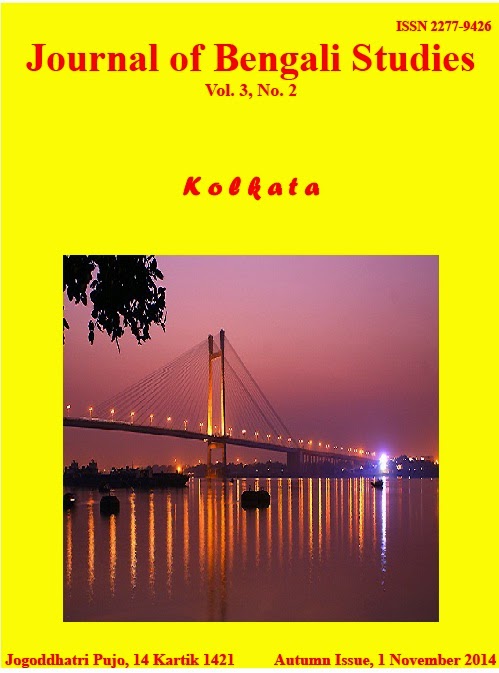
Publication of JBS Vol.3 No.2 (Themed on Kolkata) on the Occasion of Jogoddhatri Pujo, 1 November 2014

After the proud publications of our issues on Ognijug (Vol. 1, No.1), Bengali Cinema (Vol.1, No.2), Bengali Theatre (Vol.2, No.1), Science and Technology in History: Modern Bengali Perspectives (Vol.2, No.2), Literature and Movements: Bengali Crossroads (Vol.3, No.1) Journal of Bengali Studies is happy to announce the online publication of its Autumn Issue, 2014 (Vol.3, No.2), on the theme of Kolkata on the occasion of Jogoddhatri Pujo, 1 November 2014. You can read the issue by clicking on the cover image
 JBS Vol.3, No.2 (Theme: Kolkata)

ISSN: 2277-9426

Journal of Bengali Studies
Vol. 3, No. 2
1 November 2014
Jogoddhatri Pujo, 14 Kartik 1421
Autumn Issue
Kolkata


Editor: Tamal Dasgupta


Contents

Editorial


Article
CoordiNation and Deferral of Bengali Nation-Consciousness: Ishwarchandra Gupta in Nineteenth Century Kolkata
Tamal Dasgupta 16
Kolkata Corporation and Subhas Chandra Bose: Death of a Dream
Chandrachur Ghose 84
Echoes from the Past: Revisiting ‘Old Kolkata’ in Gorosthane Sabdhan
Kallol Gangopadhyay 126
A Lesson in Living Life: The Portrayal of Kolkata in Satyajit Ray’s Short Stories
Zenith Roy 147
Demographic and Behavioral Profile of Street Children in Kolkata
Atanu Ghosh 164
Cottage and Small Scale Industries in the Slums of Kolkata: Growth and Constraints in Twentieth Century
Subrata Nandi 176
Kolkata's Intellectual Response to Shakespeare: Academia, Stage and Little Magazines
Arindam Mukherjee 191


Tracing the Historical Roots of Kolkata's North-South Divide
Madhusree Chattopadhyay 229


Review
Scanning Kolkata Stage through the Eyes of Five Doyens: A Review of Bratya Basu's Book of Interviews
Sourav Gupta 247


Workshop
Love and Kolkata: Six Poems
Tamal Dasgupta 251


Commentary
Sister Nivedita in Kolkata: A Nation Awakens
Mousumi Bandyopadhyay 267
Living Heritage: Boats of Kolkata
Swarup Bhattacharyya 278
Traditional Sanskrit Learning in Kolkata
Somnath Sarkar 298