Friday, 31 October 2014

Publication of JBS Vol.3 No.2 (Themed on Kolkata) on the Occasion of Jogoddhatri Pujo, 1 November 2014

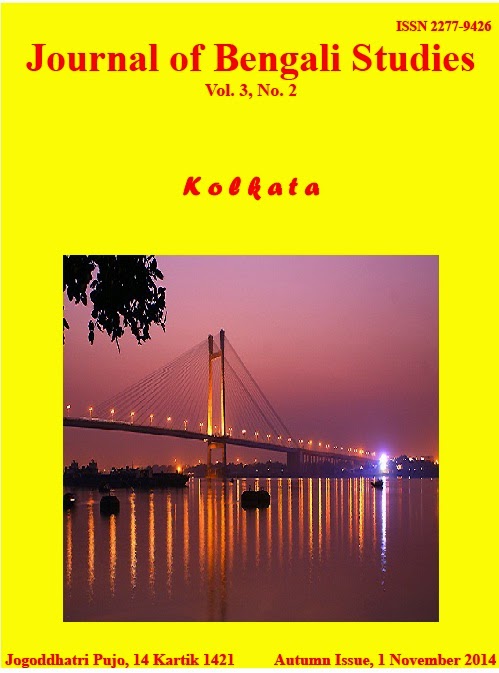
After the proud publications of our issues on Ognijug (Vol. 1, No.1), Bengali Cinema (Vol.1, No.2), Bengali Theatre (Vol.2, No.1), Science and Technology in History: Modern Bengali Perspectives (Vol.2, No.2), Literature and Movements: Bengali Crossroads (Vol.3, No.1) Journal of Bengali Studies is happy to announce the online publication of its Autumn Issue, 2014 (Vol.3, No.2), on the theme of Kolkata on the occasion of Jogoddhatri Pujo, 1 November 2014. You can read the issue by clicking on the cover image
 JBS Vol.3, No.2 (Theme: Kolkata)

ISSN: 2277-9426

Journal of Bengali Studies
Vol. 3, No. 2
1 November 2014
Jogoddhatri Pujo, 14 Kartik 1421
Autumn Issue
Kolkata


Editor: Tamal Dasgupta


Contents

Editorial


Article
CoordiNation and Deferral of Bengali Nation-Consciousness: Ishwarchandra Gupta in Nineteenth Century Kolkata
Tamal Dasgupta 16
Kolkata Corporation and Subhas Chandra Bose: Death of a Dream
Chandrachur Ghose 84
Echoes from the Past: Revisiting ‘Old Kolkata’ in Gorosthane Sabdhan
Kallol Gangopadhyay 126
A Lesson in Living Life: The Portrayal of Kolkata in Satyajit Ray’s Short Stories
Zenith Roy 147
Demographic and Behavioral Profile of Street Children in Kolkata
Atanu Ghosh 164
Cottage and Small Scale Industries in the Slums of Kolkata: Growth and Constraints in Twentieth Century
Subrata Nandi 176
Kolkata's Intellectual Response to Shakespeare: Academia, Stage and Little Magazines
Arindam Mukherjee 191


Tracing the Historical Roots of Kolkata's North-South Divide
Madhusree Chattopadhyay 229


Review
Scanning Kolkata Stage through the Eyes of Five Doyens: A Review of Bratya Basu's Book of Interviews
Sourav Gupta 247


Workshop
Love and Kolkata: Six Poems
Tamal Dasgupta 251


Commentary
Sister Nivedita in Kolkata: A Nation Awakens
Mousumi Bandyopadhyay 267
Living Heritage: Boats of Kolkata
Swarup Bhattacharyya 278
Traditional Sanskrit Learning in Kolkata
Somnath Sarkar 298


Saturday, 24 May 2014

Call for Papers for JBS Vol.3, No.2 on the theme of 'Kolkata'

After the proud publications of our issues on Ognijug, the age of revolutionary nationalism in Bengal (Vol.1, No.1), Bengali Cinema: Bengalis and Cinema (Vol.1, No.2), Bengali Theatre: Bengalis and Theatre (Vol.2, No.1), Science and Technology in History: Modern Bengali Perspectives (Vol.2, No.2), Literature and Movements: Bengali Crossroads (Vol.3, No.1), Journal of Bengali Studies (JBS), a peer reviewed interdisciplinary online academic journal (ISSN: 2277- 9426) meant for scholarly discussions into the history and culture of the Indic Bengali people, is pleased to announce the Call for Papers for its sixth issue (Vol.3, No.2) on the theme of Kolkata due to be published on the occasion of Kalipujo, 23 October 2014. The final date for submission of article/review/workshop is 30 September 2014. Commentaries in JBS are accepted by invitation/commission alone. If you want to author a commentary instead of a regular article or review, or want to know how they are different, please get in touch with the editorial board beforehand at shoptodina@gmail.com

Kolkata

The theme of this issue is Kolkata. Dinesh Chandra Sen writes in his Brihot Bongo (where one of the main theses runs as that the Bengalis are the inheritors of the ancient flourish of philosophy, culture, politics and science which eastern India witnessed since the rise of Magadh) that Kolkata, via medieval Nabadwip and ancient Gour, is the legacy bearer of the ancient Magadhan civilisation (174). So, we begin by suggesting that Kolkata is not (merely) a colonial legacy, that it was not established by one Job Charnock, and that the place in all likelihood derives its name from Kalikhetro.

The topics for contribution will include the following but will not be limited to the same:

The ancient and medieval recorded mentions of Kolkata prior to British arrival. A riverine history of Kolkata. Kolkata waterbodies.

Chouranginath, the ancient Nath saint (reputed to be a Pal prince) and Chowringhee.

The related history of South Bengal kingdoms since ancient times and Kolkata's rootedness in that history; vicinity to the Bay of Bengal, sea port of Tamralipta, the Gangariddae of Ptolemy.

Kolkata and the empire of Pratapaditya of Jessore.

Kalighat.

Kolkata and other Europeans prior to the British East India Company. British arrival and the Hindu response; Hindu consolidation against the misrule of Siraj. Beginning of Durgapujo by Nabakrishna of Kolkata and Krishnachandra of Nadia to celebrate the overthrow of Islamic rule.

Bengali compradorship. The dialectics of collaboration and conflict. Tagore family as a type. Collision of the east and west resulting in early Renaissance: Rammohan Roy. The flourish of Brahmo Movement and Debendranath Tagore.

The beginning of a Native resistance and Hindu revival. Rani Rashmoni.

Bengal Renaissance: Giants like Vidyasagar, Michael, Bankim, Vivekananda.

Kolkata and the flourish of periodicals, newspapers, journals and magazines. Kolkata and little magazines. Kolkata's printing press and publishing industry. Chapbooks and Bot tola. Kolkata bookshops.

The rise and fall of Bengali business class. Kolkata's eventual domination by non-Bengali business interests.

Kolkata and literature (Bengali and English): Poetry, Novels, Short Stories, Essays.

Kolkata's dialect of Bengali: Kolkata's spoken tongue.

Kolkata and food: Kolkata's food history. Kolkata cuisine, Kolkata eateries.

Kolkata's landmarks. Kolkata streets and crossroads. Tematha, Coumatha and Panchmatha. Kolkata's urban space. North versus South. Officepara. Shahebpara. College Street. Kolkata's entry points: Sealdah and Howrah. Kolkata's new townships and satelites.

Kolkata: music and poetry. From Gojla Guin to Nidhubabu to Bangla band. Kolkata and Kobiyals. Ishwar Gupta and Kolkata. Rupchand Pokkhi and urban decadence.

Kolkata and politics. Kolkata and movements. Congress. Kolkata and the anti-partition movement of 1905. Kolkata and the Revolutionary Nationalists. Kolkata and C R Das; Kolkata and Subhash Bose. Kolkata and the communists. Kolkata and Muslim League. Suhrawardy. Direct Action Day. The Great Calcutta Killing. Partition of 1947. Kolkata and East Bengal refugees.

Kolkata and erudition; Kolkata and academia.

Kolkata and theatre. Kolkata and cinema.

Kolkata's downtrodeen: slums, pavement dwellers, homeless. Kolkata underworld and Kolkata's fictional as well as historical detectives.

Kolkata and the Bengali babudom.

General details about submissions to Journal of Bengali Studies:
Journal of Bengali Studies is published in English and is an online journal. A contribution must be electronic and in English language. It should consistently follow any one of these three scholarly styles of citation: MLA style, Chicago Manual of Style and APA style. Contributions must always be 1.5 line-spaced. An article, with notes and bibliography, should not be more than 10000 words. In case of reviews, the upper limit is 2000 words; we welcome reviews of new books as well as old and out of print ones, not necessarily of books written in English alone; we accept reviews of books, texts and artworks (new and old alike) which are related to our theme. From our Cinema issue onwards, we started a section (in addition to articles and reviews) called Workshop: Theory in Practice. This section features creative/critical works which are related to our theme. Any kind of creative/literary writing that concerns Kolkata is welcome in this issue; a priority may be given to historical fictions/plays/poetry, which may be originally written in Bengali, in which case it has to be in English translation, or it may be originally written in English. In either case, it should focus on our theme and be relevant to the CFP. The workshop may also include critical writings, for example, the narration of one's experiences in Kolkata, exploring the question of one's involvement with the social, cultural, literary, economic and political aspects of Kolkata. Upper Limit of Creative Workshop: 10000 words. We have no lower word limit for the contributions, the authors are free to use their discretion. Contributions should only be in MS Word, Open Office, or RTF format and should be emailed to all of these three email ids: editorbengalistudies@gmail.com, editjbs@gmail.com and shoptodina@gmail.com. Before submission, please see our Submission Guidelines and Terms and Conditions at
http://bengalistudies.blogspot.in/. For further details about the objectives of our journal, please see the JBS Manifesto at http://bengalistudies.blogspot.in/.

Editor: Tamal Dasgupta

Issue Editor: Subrata Nandi

Editorial Board: Sourav Gupta

Mousumi Biswas Dasgupta


Sunday, 11 May 2014

JBS Current Issue Vol.3 No.1 (Literature and Movements: Bengali Crossroads) is published


After the proud publications of our issues on Ognijug (Vol. 1, No.1), Bengali Cinema (Vol.1, No.2), Bengali Theatre (Vol.2, No.1), Science and Technology in History: Modern Bengali Perspectives (Vol.2, No.2) Journal of Bengali Studies is happy to announce the online publication of our Summer Issue 2014 (Vol.3, No.1), on the theme of Literature and Movements: Bengali Crossroads on the occasion of Buddhapurnima, 14 May 2014. You can read the issue by clicking at this link: Literature and Movements: Bengali Crossroads (JBS Vol.3 No.1)


http://www.scribd.com/doc/223387769/Journal-of-Bengali-Studies-Vol-3-No-1

ISSN: 2277-9426

Journal of Bengali Studies


Vol. 3, No. 1

14 May 2014
Buddhapurnima, 30 Boishakh 1421

Summer Issue


Literature and Movements:

Bengali Crossroads


Editor: Tamal Dasgupta
Contents


Editorial 7
Articles

The Radha Idea at the Crossroads of History, Culture and Politics:Gitagovindaand the Boishnob Movement in Bengal
Tamal Dasgupta 14

Shakto Literature and the ‘Durga-Kali’ Paradigm: Prabhat Kumar Mukhopadhyay’s “The Goddess” as Satyajit Ray’s Devi
Kaustav Kundu 43
Bratya Basu’s Plays: Challenging Hegemony from between the Eyebrows of Time
Sourav Gupta 71
From Suffering to Revolt and Rejection: A Study of the Bengali Dalit Narratives by Jatin Bala and Utthanpada Bijali
Asit Panda 90
Nitai in Boishnob Movement and Literature
Sayantan Thakur 106

The Movement Within: A Secret Guide to Esoteric Kaayaasaadhanaa inCaryaapada
Debaprasad Bandyopadhyay 113

Partition of India and the Chronicle of the Eastern Frontier: Mapping the Short Fictions in Bengali on Migration, Displacement and Refugee Struggle
Kallol Gangopadhyay 128
Michael Madhusudan’s Collaboration and Collusion with Dominant Colonial Culture inMeghanadbadh Kavya
Deb Dulal Halder 136
Literature & Movement in the Mahishasurmardini-Selected Verses of the Devi Mahatmya/ Durga Saptashati and the Bengali Crossroads
Sanjay Kumar 148

Reviews
Liberal Individualism in the Early Career of Utpal Dutt and Nationalism in the Twilight of Amritalal Basu's Life: A Review of Encore and Roshoraajer Roshokothon
Mousumi Biswas Dasgupta 172

Dhorai Charita Manas: A Documentation of Gandhian Myth and Indian Freedom Movement
Saptarshi Maity 177

Workshop
Seeing, Beyond Seeing: Poetry of Movement and Movement of Poetry
Debanjan Das 181
Commentaries
Boats in Chuyachandan
Swarup Bhattacharya 185
Hungry Movement after 50 Years
Nachiketa Bandyopadhyay 189


Wednesday, 19 March 2014

Announcement

Message from the Editorial Board

Hello, season's greetings, and best wishes for the upcoming Bengali New Year 1421!

Works are currently in full swing for our Vol.3, No.1 (Literature and Movements: Bengali Crossroads). It would be published on the occasion of Buddha Purnima. Please note that the final date of submission has been modified to 20 April 2014 owing to editorial compulsions. We solicit co-operation from our contributors in this regard.

The Call for Papers for Vol.3, No.2 will be uploaded soon.

We are glad to announce that we shall henceforth be live at www.bengalistudies.com. We shall of course continue publishing our materials on this blog.

From this upcoming issue, we shall provide separate exclusive links to every individual author's articles, reviews etc. We shall soon provide the same for our old issues as well. Check out www.bengalistudies.com for details.

Thank you very much!


Thursday, 9 January 2014

Call for Papers for JBS Vol.3, No.1 (Literature and Movements: Bengali Crossroads)

After the proud publication of our inaugural issue on Ognijug, the age of revolutionary nationalism in Bengal, and the consecutive issues respectively on Bengali Cinema: Bengalis and Cinema (Vol.1, No.2), Bengali Theatre: Bengalis and Theatre (Vol.2, No.1), Science and Technology in History: Bengali Perspectives (Vol.2, No.2), Journal of Bengali Studies (JBS), a peer reviewed academic interdisciplinary online journal (ISSN: 2277- 9426) meant for discussions into the history and culture of the Indic Bengali people, is pleased to announce the Call for Papers for its fifth issue on the theme of Literature of Movements: Bengali Crossroads (Vol.3, No.1), due to be published on the occasion of Buddha Purnima, 14 May 2014. The final date for submission of article/review/workshop is 30 April 2014.

Literature and Movements: Bengali Crossroads

The theme of this issue is centred on the interrelationship between the literature produced by the Bengalis (not necessarily written in Bengali alone) during a given historical period and the social, cultural and political ferments of that age. We argue that since antiquity, Bengal witnesses a number of intellectual, cultural and social ferments which have actively interacted with literature; here it may be pertinent to recall Tamal Dasgupta's theorisation of the interactions between history and literature from his article "Understanding Hi-story" in JBS inaugural issue:


The relationship between history and story (narrative/art/literature) works at multiple levels. Historical fiction in Bengal is well established as a genre that began with Bankim Chandra. Secondly, fictionalised history (different from historical fiction) is a popular format and just like popular science it offers documentary-fiction, and as a classic example of that we have Sailesh Dey's
Ami Subhash Bolchi (This is Subhash Speaking). In recent times, Shankar's Ami Vivekananda Bolchi (This is Vivekananda Speaking) is a specimen that falls within this genre. Thirdly, history can be made by stories as well, so the novels of Bankim which created nationalist history, like Anandamath did, constitutes another category; stories which gave birth to history. A similar example from abroad is the Russian novel What is to be Done by Nikolai Chernyshevsky (Lenin, who was a lifelong admirer of Chernyshevsky, took the title of his eponymous history-making treatise from this novel). Another category, the fourth one includes the plethora of narratives and legends and stories/songs/poems which accompanied the events of revolutionary nationalism, for instance Sharatchandra's Pother Dabi (The Demand of the Path), and the revolutionary songs and poems of Nazrul Islam (both the writers were actively involved with the revolutionaries); later on, similar narratives were made to describe the continuity, legacy and heritage of the revolutionary nationalist movement as inherited by the communist party.


Thus the relationship between literature and movements during a given historical period is dynamic, multi-faceted and interactive.
The relationship is never one way, and literature is never simply a reflection of social, cultural and political movements: literature is sometimes the most significant determinant of those movements.


The important topics for contribution will include the following (but will not be exclusively limited to the same):

Ancient times to the early middle ages and the flourish of literature in Bengal. Sanskrit and Prakrit literature produced in Bengal and the Indic religious and social ferments. Chorjapod and Buddhism;
the seeds of tantra, shakti, mystical cults of baul-sahajiya etc.

Jayadeva's Gitgovinda and Vaishnavism. Jayadeva as an essentially Bengali poet whose Gitgovinda celebrates Radha-idea which is in tune with Bengal, not with the Jagannath worship of Orissa (for historical evidences of Jayadeva as a Bengali poet, one may refer to P K Dasgupta's excellent treatise, Jayadeva and Some of His Contemporaries).

Chandidas's ShriKrishnaKirtan. The flourish of Vaishnav literature in the middle ages and Chaitanya movement.

Social engineering of the middle ages and Mongol Kabyo.

Shakto literature and the flourish of Shakti worship: from late middle ages to the modern period; beginning of Durga Puja and Agomoni songs. Shyama songs and Kali puja.

Bengal Renaissance and literature.

Registers of popular ferments: literature of Bot tola.

Hindu Revival and literature: Bankim Chandra and others.

Literature celebrating the glorious past of Bengal, and Bengali nationalism.

Literature and Ognijug.

Literature and the communist and naxalite movements.

Literature and the refugees; registering the trauma of the Hindus uprooted from East Bengal, the experiences of Noakhali, Marichjhapi and post-independence Bangladesh. Taslima Nasrin's Lajja, Amitav Ghosh's Hungry Tides.

The Eurocentric turn of modern and postmodern Bengali literature (Buddhadeb Basu wanted to emphasise that Bengal was culturally a province of Europe) and the dominant left-liberal-universalist milieu of the bhadralok-comprador classes. Globalisation and contemporary Bengali literature.

Group theatre movement and Bengali theatrical literature.

The Hindu response to Eurocentrism:
The non-communist, non-materialistic movements of literature, most notably the works of Kamal Kumar Majumdar.

Poetry and politics in Bengal.

Literature and the overturning of the communist regime: Bratyo Basu's plays, Joy Goswami's poetry and Kabir Suman's songs.


General details about submissions to Journal of Bengali Studies:

Journal of Bengali Studies is published in English and is an online journal. A contribution must be electronic and in English language. It should consistently follow any one of these three scholarly styles of citation: MLA style, Chicago Manual of Style and APA style. Contributions must always be double spaced. An article, with notes and bibliography, should not be more than 10000 words. In case of reviews, the upper limit is 2000 words; we welcome reviews of new books as well as old and out of print ones, not necessarily of books written in English alone; we accept reviews of books, texts and artworks (new and old alike) which are related to our theme. From our Cinema issue onwards, we started a section (in addition to articles and reviews) called Workshop: Theory in Practice. This section features creative/critical works which are related to our theme. Any kind of creative/literary writing that concerns the relationship between Bengalis and social, cultural and political movements is welcome in this issue; a priority may be given to historical and political fictions/plays/poetry, which may be originally written in Bengali, in which case it has to be in English translation, or it may be originally written in English. In either case, it should focus on our theme and be relevant to the CFP. The workshop may also include critical writings, for example, the narration of the experiences in one's creative/literary/artistic field/profession, exploring the question of a writer's involvement with social, cultural and political movements. Upper Limit of Creative Workshop: 10000 words. We have no lower word limit for the contributions, the authors are free to use their discretion. Contributions should either be in MS Word, Open Office, or RTF format and should be emailed to all of these three email ids: editorbengalistudies@gmail.com, editjbs@gmail.com and shoptodina@gmail.com. Before submission, please see our Submission Guidelines and Terms and Conditions for further details at
http://bengalistudies.blogspot.in/. For further ideas about the objectives of our journal, please see the JBS Manifesto at http://bengalistudies.blogspot.in/.

Editor: Mousumi Biswas Dasgupta

Editorial Board: Tamal Dasgupta (founder-editor), Sourav Gupta, Joydeep Bhattacharya, Saptarshi Mallick.


Friday, 18 October 2013

JBS Vol.2, No.2 Is Now Online

The Autumn Issue of Journal of Bengali Studies 2013 (Vol.2, No.2), a peer reviewed interdisciplinary online academic journal, has been published on the occasion of Kojagori Lokkhipurnima. You can read the journal here (click on the cover image):


ISSN: 2277-9426

Journal of Bengali Studies


Vol. 2, No. 2


18 October 2013


Kojagori Lokkhipujo, 31 Aashshin 1420


Autumn Issue


Science and Technology in History:

Modern Bengali Perspectives


Issue Editor: Mousumi Biswas Dasgupta

Asst. Issue Editor: Joydeep Bhattacharya


Editor: Tamal Dasgupta

Asst. Editor: Sourav Gupta


Contents


Editorial 5


Articles


The Deprived Technologist: Hiralal Sen and Bioscope

Sourav Gupta 8


Mahendralal Sarkar and His Indian Association for Cultivation of Science

Soumen Ghosh 17


Conveyance in Bengal Waterfront and Its Technological Excellence

Swarup Bhattacharya 31


Reviews


A Nationalist Approach towards Science and Technology: A Review of Acharya Prafulla Chandra Roy's Collected Essays (in Bengali)

Tamal Dasgupta 47


A Review of Kadambini Ganguly: The Archetypal Woman Of Nineteenth Century Bengal by

Mousumi Bandyopadhyay

Mousumi Biswas Dasgupta 55


Workshop


Field Notes: The History of Modern Pharmaceutical Technology in Bengal

Tanushree Singha 61


Commentary


The Lady Doctors: Bengali Women in Medical Science in the Modern Period

Nachiketa Bandyopadhyay 67


Saturday, 4 May 2013

CALL FOR PAPERS: JBS VOL.2, NO.2

Please Note: This issue has been published. Check out this space for our new Call for Papers


CALL FOR PAPERS:

After the proud publication of our inaugural issue on Ognijug, the age of revolutionary nationalism in Bengal, and the consecutive issues respectively on Bengali Cinema: Bengalis and Cinema (Vol.1, No.2) and Bengali Theatre: Bengalis and Theatre (Vol.2, No.1), Journal of Bengali Studies (JBS), a peer reviewed academic interdisciplinary online journal (ISSN: 2277- 9426) meant for discussions into the history and culture of the Indic Bengali people, is pleased to announce the Call for Papers for its fourth issue (Vol.2, No.2) on the theme of Science and Technology in History: Bengali Perspectives, due to be published on the occasion of Durga Pujo, 2013. The final date for submission of article/review/workshop is 30 September 2013.  


Science and Technology in History: Bengali Perspectives

The important topics for contribution will include the following (but will not be exclusively limited to the same):
Ancient times to the early middle ages and the flourish of science and technology in the Eastern Indic civilizations of which Bengal was the prominent seat:

The flourish of Ayurveda and pharmaceutical sciences.

Civil Engineering, architecture and draftsmanship.

Metallurgy, and other branches of Inorganic chemistry.

Sculptural technology, woodcraft, terracotta, different forms of handicraft.

Textile technology.

Navigation.

Irrigation and other forms of water management.

Agriculture, Fishing technology, Veterinary sciences, and other Biological sciences.

Physical sciences.

Linguistics, grammar and philology.

Military technology.


The general setback suffered by the Indic science and technology in the middle ages by Islamic invasion (the destruction of Nalanda University immediately coming to mind); later, the appropriation of the native science and technology by the Islamic rulers.


The British colonization. British destruction of native knowledge and technology, immediately coming to mind is the brutal annihilation of superior textile technology of Bengal by cutting out the thumbs of Bengali muslin weavers. Also, the systematic uprooting of Ayurveda by encouragement given to Western system of medicine.

Bengalis' encounters with western science and technology.

Asiatic society and the flourish of philology and archeology.

The establishment of Medical College in Calcutta in 1835, and Bengal Engineering College at Shibpur in 1856.

Bengal renaissance, the nationalist awakening and the flourish of science and technology in Bengal. Bankim Chandra's tome of writings on modern science.

Mahendralal Sarkar's establishment of Indian Association for the Cultivation of Science. Presidency College and Calcutta University. The great scientists during Bengal Renaissance: J.C. Bose and others.

The spirit of Hindu Revival in A.P.C. Ray's History of Hindu Chemistry. Tagore's exchange with A.P.C. Ray regarding the chemist-turned-litterateur Rajshekhar Basu (whose brother Girindrashekhar was the first Freudian psychoanalyst in the entire non-Western world) exhibiting the tremendous amount of talent which went into the cultivation of science and technology in Bengal.

Developments in Printing technology. Upendrakishore (U. Ray and Sons) as a case study.

Bengali nationalism and Bengal Chemicals of A.P.C. Ray.

Ognijug and the flourish of science and technology in an overall atmosphere of nationalism.

Establishment of Bengal Technical Institute in 1906 and its later merger with National Council of Education in 1910, a merger that gave birth to what is known today as the Jadavpur University. The contribution of Jadavpur University towards advancements in science, engineering and technology.

The sustained flourish of Calcutta University's Science Colleges.
The phenomenal, original contributions of Satyen Bose, Prasanta Mahalanobis, Meghnad Saha and other such luminaries.
Interactions and exchanges: science and technology, and other disciplines. Science and literature, Bengali science fictions. Popular Science. Science and philosophy. Science and art and culture. Technology and Bengali cinema (particularly early Bengali cinema, prior to the left-IPTA take-over of Bengali cultural scenario; for a brief idea of the technological superiority of early Bengali cinema one may refer to Tamal Dasgupta's article in the JBS cinema issue).


Post-Independence to the present. The stagnation. The flight of talents. Bengali bhadralok fascination with Joint Entrance Examination (for admissions into Medical and Engineering). Left domination and the degeneration of science and technology in Bengal, immediately coming to mind the fate of Doctor Subhash Mukhopadhyay (on the basis of whose tragic but nevertheless pioneering life, Tapan Sinha made the movie Ek Doctor Ki Maut). The paradox of largely left dominated so-called science movements (so-called rationalist movements) in Bengal which could not arrest, but perhaps further fueled the degeneration and decline of the dilapidated condition of cultivation of science in Bengal that increasingly embraced mediocrity; the vulgar Marxist, mechanically materialist outlook of such movements, so aptly touched upon in Nabarun Bhattacharya's Herbert.  


General details about submissions to Journal of Bengali Studies:
Journal of Bengali Studies is published in English and is an online journal. A Contribution must be electronic and in English language. It should consistently follow any one of these three scholarly styles of citation: MLA style, Chicago Manual of Style and APA style. Contributions must always be double spaced. An article, with notes and bibliography, should not be more than 10000 words. In case of reviews, the upper limit is 2000 words; we welcome reviews of new books as well as old and out of print ones, not necessarily of books written in English alone; we accept  reviews of science and technology related books, texts and artworks (new and old alike). From our Cinema issue onwards, we started a section (in addition to articles and reviews) called Workshop: Theory in Practice. This section features creative/critical works which are related to our theme. Any kind of creative writing that concerns the relationship between Bengalis and science is welcome for this issue; a priority may be given to science fiction stories, which may be originally written in Bengali, in which case it has to be in English translation, or it may be originally written in English. In either case, it should focus on our theme and be relevant to the CFP. The workshop may also include critical writings, for example, the narration of the experiences in one's particular field/profession, exploring the question of the Bengalis' involvement with science and technology. Upper Limit of Creative Workshop: 10000 words. We have no lower word limit for the contributions, the authors are free to use their discretion. Contributions should either be in MS Word, Open Office, or RTF format and should be emailed to all of these three email ids: editorbengalistudies@gmail.com, editjbs@gmail.com and shoptodina@gmail.com. Before submission, please see our Submission Guidelines and Terms and Conditions for further details at http://bengalistudies.blogspot.in/. For further ideas about the objectives of our journal, please see the JBS Manifesto at http://bengalistudies.blogspot.in/.

Editor: Tamal Dasgupta

Editorial Board: Sourav Gupta, Sujay Chatterjee, Rishi Ghosh, Nirvik Banerjee.

For this science and technology issue of JBS, Mousumi Biswas Dasgupta will be the issue editor.